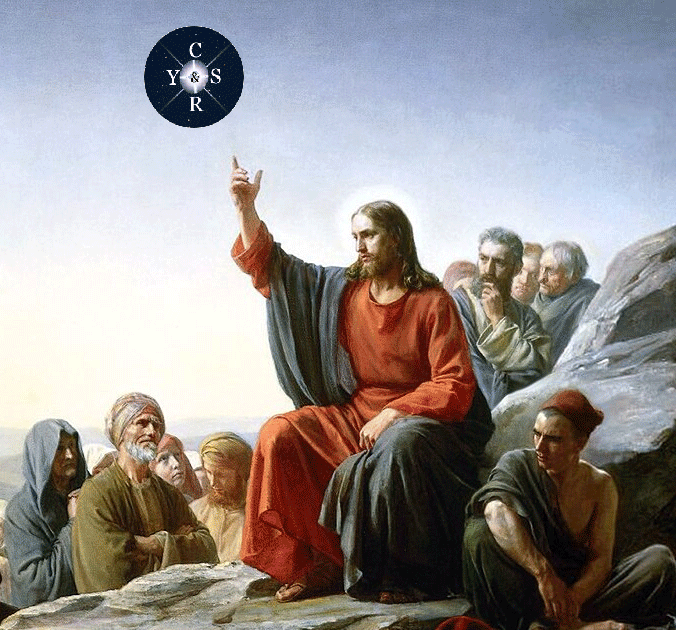
 |
THE INTELLECTUAL REVOLUTION OF THE MORNING STAR |
This is Today´s Will of God:"Let's unify all the churches into One" |
DIVINE HISTORYPREHISTORY OF CHRISTIANITYAND THE FOUNDATION OF THE KINGDOM OF GOD1. Origins
Thus, all those things that concern us and make up the
History of the Fulness of the Nations had their beginning in another World, in
another place of the Universe, in a realm situated beyond the stars of Heaven,
at the very heart of the kingdom of the galaxies.
There, at the center of His Creation, God fashioned
His own World: the World from which His Son descended into ours, and to which
He returned after His Resurrection.
The Son of God spoke of it many times, yet His words
found neither ears willing to listen nor minds able to understand His message.
One of the clearest occasions on which He spoke of His native World was before
Pontius Pilate:
“My Kingdom is not of this world. If my Kingdom were
of this world, my servants would have fought so that I should not be delivered
to the Jews. But my Kingdom is not from here.”
On many other occasions Jesus returned to the subject
of His origin and never hesitated to make it known that He came from another
World, that He had left His World and descended into ours in order to deliver
us from Ignorance and lead us into Wisdom.
In the Third Chapter of the HEART OF MARYF, I addressed the
origin of Heaven, that World from which the Son of God came. I attempted,
insofar as possible, to recover the memory of its chronicles and to follow the
trail of its wars to the point where they touch us directly.
I believe I stated there that God created that World,
from which He sent His Son to us, to be His Home, His Homeland, His
Country, His Property, His Paradise. And He created it entirely according to
His own measure and delight.
For its boundaries He gave it the Dawn that flies upon
the wings of Infinity; for its future He gave it the Morning that forever rises
and lives eternally in the eyes of Eternity.
In other words, He fashioned it after the image and
likeness of the Idea that stirred within His Mind concerning the nature and
constitution of the New Cosmos He intended to raise immediately after
completing the creation of His World.
The idea of the Cosmos that God held in His Mind
before setting His hand to Universal Reality may be described by two principal
characteristics:
First, ad Infinitum expansion of its frontiers.
Second, ad eternum unfolding of its future.
Resolved to become the Source of this New Universal
Reality, born from the union of Space and Time within a material Core, the
geographical center of the New Cosmos, God gave that Core a body. He endowed it
with its own nature, possessing a singular, unique, and unrepeatable identity.
Born to be the geographical heart of His Creation, the
point of intersection between the two uncreated vectors, Infinity and Eternity,
God made its existence tangible and bestowed upon it a natural
indestructibility akin to His own Being. He also granted it the capacity for
growth inherent to Space and Time themselves.
That World would be His World, His Home, His Homeland,
His Paradise, His Property, His Country, His Land, His Everything: the thing
He had never possessed.
For all eternity, God had been a wanderer through
Eternity, an adventurer across Infinity. Now He would create what He had never
had before: His own Home, His own World. And He would create it without
limitation of means and without lack of imagination.
And so He did. How he did it doesn't matter. In the case of the creation of our Universe, the How does matter. In the Introduction to 21st Century Cosmology, I touched on this topic. In the third Part of the First Book of Divine History, I said that we will already have time to fully know this World whose Origin we are dealing with in this book. Which leads me to say what I’ve already said elsewhere, that there are things within our sphere of knowledge and others, like the Birth of the Father and the Son, and the creation of this World born to be the Homeland of its Creator, that escape the physical understanding of our intelligence. Claiming in the style of the ancients, even though they preferred to be called modern, that what we cannot understand does not exist is a declaration of madness. We are living creatures with intelligence because of the Intelligence of our Creator, and even though our Creator set limits to our intelligence, we must not forget that there are things beyond the reach of physical sciences and that only life experience can confirm their existence. In this case, we are talking about Wisdom. The mistake, the root of the ancients' madness, even though they demanded to be called modern, was trying to subject Wisdom to Science. So, and so we wouldn’t get lost, God raised a Mountain in the heart of His World. And at its summit, a City was built. But knowing that it’s not twelve walls that make a House, but those who live inside, He dreamed of Brothers, Friends, Children. Such is the origin of the gods of Heaven. Then it happened that God begot from His Being; and in Fatherhood, His mind and heart found perfect happiness. He presented His Son to the gods, and they worshiped Him. Eventually, God began to create the Universe. The Galaxies set their fields of stars at the service of their Lord, and from the peaks of their distant mountain ranges, rivers of starsmade their way through the sidereal plains. Like someone giving a head of a wave machine to a swift, fresh, and joyful current, those luminous beds began to descend from all the heights of the Cosmos. This is the origin of the Universe. Like gravitational strings dragging a train of stars of all sizes and colors, those rivers of stars flowed into the ocean of the constellations of the Heavens. And so the Universe was created..
2. The Ancient Gods
As time passed, Heaven became a Kingdom, and the
Kingdom became an Empire.
On the Sixth Day, God created Man.
Such is the origin of the sons of God, the gods of
ancient times.
3. The Cradle of Man
There were five Worlds that God created and
transported from their places of origin in the Universe to His own World, His
Paradise.
Man had not yet been created.
Indeed, the very idea of Man had not yet arisen in the
mind of the Creator.
To those who ask whether there is life in the
Universe, we answer: yes, there is, for we ourselves exist.
And to those who ask whether life existed before us,
we answer likewise: yes. We were neither the first nor shall we be the last.
If they then ask in what star, in what region of
Heaven, those other peoples of the Universe dwell, we shall say that their
homes are in the World God built for Himself, the World that stands Above, at
the very center of His Creation.
There too is our dwelling place: that living and
indestructible World. There, above, we shall all meet again and share the
eternal life for which we were created.
Yet duty compels us to return from the Future to the
Past, to the days when Hell sowed the seed of War within Paradise.
Two wars devastated Paradise, though Heaven itself was
never conquered.
The great battles fought for the throne of the King of
Kings and Lord of Lords are written in the Book of Life. Its pages tell how the
brothers and sons of God who remained faithful to the Crown of the
Only-Begotten shattered the strength of the Rebel Axis, broke open the Seal of
Fidelity, and saw the very elements of Nature come to the service of their
arms, arms beautiful, invincible, wise, and strong.
As one who borrows brilliance from lightning and
advances against darkness with its radiance in his eyes;
or as one who takes thunder for the tent of his
throat, turning the sky of his mouth into the firmament across which the horse
of the winds runs;
or as one who borrows from the bolt its mystery and
uses its electric cords as a whip upon the Beast;
so, yes, so was the massive and overwhelming
counterattack of the Princes of Heaven against the hosts of Hell which, in
God's absence, had risen against His Empire.
Twice the Dragon was subdued and captured.
Twice the Rebels were forgiven.
For in His Father's love, God believed that with time
His rebellious sons would change, and that as they grew and matured, their
desire for war would fade away.
But seeing that events demanded from Him decisions of a revolutionary kind, on the Sixth Day of the First Week of the Creation of the Universe, God conceived Man within His mind. Something new was required. For this reason, God envisioned a race capable of advancing through knowledge, experience, and choice. Humanity would become both witness and participant in a greater history. Through its journey, the conflict that had shaken Heaven would find a new field in which to unfold and, ultimately, a path toward resolution.
4. The Light
When God conceived Man, He also conceived the World
that would become his home.
God created our world by bringing forth the Heavens from the bosom of the waters of the stellar ocean. Then he created the Earth. But first came the Idea.The Earth was not created as an afterthought. Nor was
it merely one more world among many. From the beginning, it was destined to
occupy a singular place within the designs of the Creator.
In His Omniscience, the Creator does nothing without first weaving the Building to be constructed into His Intelligence. He first plans, resolves, draws lines, calculates, overcomes problems, clears unknowns, sees in virtual motion the end toward which His project leans, lets Himself be guided by His Wisdom, and then moves into action. He trusts His experience to keep all processes under control. If along the way some element seems to slip out of His hands, He acts accordingly, improvises, makes decisions as needed, and, without distorting the Idea, keeps the movement in the originally established direction.The wars of Heaven had revealed a reality that could
no longer be ignored. The freedom granted to God's children had led some toward
wisdom and loyalty, yet others had turned that freedom into rebellion. The
problem could not be solved by force alone, nor by punishment without end.
So, he created the Earth at the edges of the Cosmos, far from Heaven and the Heavens, in the Darkness. He gave the Earth the Sun as a husband and the Planets as brothers and sisters. Sun, Earth, and Moon, and the entire planetary family, were created from a single core. After creating the solar family, God left the Earth in the Darkness, in such total and absolute solitude that it caused her to feel confused and empty, as he tells us in his Book. For it happened that, against all expectations, when it as to the Earth to which he had made all the promises of the future, the marriage with the Sun sealed from the very Origin, kisses in the Cradle, God took his whole family far, far away from the Abyss covered by the Darkness, and left her, the Earth, at the mercy of the forces of the Abyss. The icy darkness of an invincible solitude seeped into the Earth's bones, and from the cold her teeth chattered. Oh, the Earth, born among promises of motherhood in the light of laughter, applause, and exclamations from the sons of God. Beautiful in her nakedness, lovely in her smallness. Oh, the dream conceived for her, like that of a child who lives off the dream of his mother while his bones and flesh are being woven. Oh, that dream... the dream was gone! The cold froze her bones, the winds that roam the Darkness shook her trembling flesh. Oh my dream, oh my life, my God has left me and abandoned me in the Darkness with no one to defend me. Why have you abandoned me, my God? Why did you promise me the ocean, why did you make me dream of the East, the West, the North and the South, why did you dream me as the mother of so many children, my hands with wings, my hair crowned with a diadem of life-filled clouds, my feet of snow breathing spring over green valleys, why did you feed me with honey if you had destined this bitter and thick poison as my food? Am I dying? Yes, I prefer death to living without your dream. So when her Creator came back to her, the Earth was empty and "confused": because ... was He forever gone? Then He cam e back to her, and the Light was made. This is how it happened. God extended a force field that surrounded the Earth, and its surface transformed into a sea of molten lava. We're talking about the Fusion of the Primary Crust of our planet. From the depths of that sea of molten lava arose the Primordial Atmosphere. Eventually, the Earth's crust cooled, and by sublimation that atmosphere turned into a Mantle of Ice that covered the entire spherical shape of our planet from the North Pole to the South Pole. Such a Mantle of Ice was 'the Light.' And Light became the first banner of Creation.
Where Light advances, darkness retreats.
Where Light appears, direction becomes possible.
Where Light is present, life can flourish.
And God saw that the Light was good.
5. The Garden
When the Earth had been prepared and its cycles
established, God planted a Garden.
This Garden was not merely a place of beauty. It was a
meeting point between Heaven and Earth, between the visible and the invisible,
between mortality and eternity.
Into that Garden He placed the first human beings.
They were not abandoned in ignorance, nor left to
wander without purpose. They were instructed, taught, and guided.
The memory of those first teachings survives only in
fragments, scattered among myths, sacred traditions, and ancient legends. Yet
behind all such accounts remains the same enduring conviction: humanity did not
begin its journey alone.
The Creator walked among His children.
The Wisdom that sustains the stars spoke with them.
The Lord of Life shared with them the inheritance He
had prepared since before the foundations of the world.
Yet freedom remained intact.
For love cannot be compelled, loyalty cannot be
manufactured, and wisdom loses all value when choice disappears.
Therefore Man was free.
And because he was free, he could remain faithful.
Or he could fall.
6. The First Trial
No kingdom is tested in times of peace alone.
No loyalty proves itself until alternatives appear.
The ancient rebellion that had wounded Heaven cast its
shadow toward Earth, and the same questions that once stirred among the sons of
God were now presented before Man.
Would humanity seek wisdom under the guidance of its
Creator?
Or would it seek knowledge apart from Him?
Would freedom become the path toward maturity?
Or the road toward separation?
The trial was inevitable.
For beings created in freedom cannot be prevented from
choosing.
They can be instructed.
They can be warned.
They can be loved.
But they cannot be forced.
And so the First Trial began.
The consequences of that choice would extend far
beyond a single generation. They would shape the destiny of nations,
civilizations, empires, and ages yet unborn.
The history of mankind had begun.
5. The Firmament of Heavens The embrace of the Almighty. Oh, the warm embrace of the Almighty. The warmth of your muscles, oh God, is the warmth of the first kiss between virgin spouses, the warmth of a father’s first word to his baby, wrap me in your breath, my God… Oh Earth, how many verses, how many lines it wrote in its solitude, each one a white dove crossing the waters in search of the olive branch that would keep Noah's hope alive. Its joy, its runaway heart, its unleashed pulse, its vibrating nerves the day the light of the Great Spirit of its Creator shone dazzlingly, crossing the field of galaxies at the speed of thought! Its warm Voice, its tender Word, oh brothers and sisters, I am dying to pour the balm of the echo of its strings into my ears, when its Word breaks the Silence. And so it was. The Great Spirit returned, embraced her, devoured her with kisses, spoke to her, and Confusion vanished at once. Wrapped in that Mantle of Ice forged at temperatures below absolute zero, Mantle of Ice that resulted from the Fusion of the Primary Crust and Sublimation of the consequent Primordial Atmosphere, God separated the Earth from the Darkness and placed it in the Heavens. He led her to meet the Sun and the Planets. In the warmth of the encounter, the ice melted and turned into Air and Water. Under the Firmament that separated Waters from Waters, the two blocks of ice began their retreat toward the North and South poles. And since then, the Firmament remains there, separating the waters of the everyday seas from the gravitational Waters that fill outer space. The Firmament in the Word of Genesis is the Atmosphere created in thad Day. A Firmament that He also called 'heaven,' the heaven of every day, blue, red, white, yellow, orange, violet, purple. A Firmament whose architecture we will have time to explore, and speaking of which we touch on its Genesis, leaving for another place the foundations of the Biosphere, foundations that will lead us to the definition of the constituent elements of the Ecosphere. (In GENESIS, CREATION OF THE UNIVERSE, you have the wonderful opportunity to follow the creating mechanics of these processes step by step).
6. The Hand of God. The waters of the mother ocean kept receding under the Sun. And they continued to fall until they reached the level of the seas. Then, when the waters withdrew to let Life follow its course, the imprint of the Creator's Hand was engraved on the stone of the ocean ridges, and on the surface of the imprint of its five fingers, the tree of species took root. This is the origin of life on Earth..
7. The World of Birds
The seas became filled with living creatures, so many
that they could scarcely be contained within the vastness of those waters that
encircled the world. The level of the Waters beneath the Firmament continued to
fall, and as it did, the pressure increased.
Then the Tree of Life crossed the boundary between
water and air, and the firmament of Heaven became filled with creatures bearing
wings and beaks.
Other branches reached the solid earth directly,
passing from water onto land. Yet the world belonged to the birds. They laid
their eggs upon the ground and spread inland to the farthest limits of the
mountain ranges.
Thus, when the amphibians began venturing beyond the
shores and took the eggs of the ancient birds as food, the need to defend what
was their own brought about a revolutionary transformation: wings became arms.
This is the origin of all beasts that bear living
young.
8. The Sons of God
As life continued to evolve, men and their families
increased among the forests. From the borders separating their lands from the
realm of monsters, they witnessed the gods descending from Heaven.
The sons of God were distinguished from all other
creatures by the fact that they walked upright upon their legs. Great also was
the power their word exercised over every beast.
Then there awoke within mankind a singular instinct:
the instinct of intelligence. Men discovered that their natural ability to
imitate the gods offered them a path toward mastery of the world.
It was in those days that the sons of God adopted
mankind as their disciples.
9. Mesopotamia: The Land of the Earthly Paradise
God assigned to each of His sons a sphere of influence
upon the Earth.
According to the Seal that each people had received
from its heavenly mentor, the formation of the Five Original Peoples, from whom
the whole human race descends, naturally gave rise to five distinct cultures.
The Plan was to unite those five cultures into a
single civilization, from which would emerge the idea of a worldwide kingdom,
the original homeland of all the future peoples of mankind.
The crown of that kingdom would be given by God to the
First Man, who would call Him Father, and no one would have the authority to
claim that power for himself.
And so, while this process of formation among the
peoples of the Earth was unfolding, families arriving from many different
regions met together in Mesopotamia, known in modern times as Iraq.
They formed societies, built cities, and established
systems of social order.
Yet never did they presume to grant themselves the
power to choose a king and undertake, by their own authority, the work of
unifying all the peoples of the Earth into one great kingdom.
God would give.
10. Adam and Eve
And He did.
The findings of archaeology surrounding the First
Civilization, discovered between the great rivers of Mesopotamia, allow us to
relate the Golden Age of the Neolithic and its Agricultural Revolution during
the fifth millennium BC to the foundation of the city-states from whose union
there emerged the first kingdom ever known upon Earth.
From families to cities, and from cities to the
Kingdom of God on Earth, this was the Universal Movement along whose guiding
lines the History of Humanity embarked upon its great Adventure under the
guidance of the sons of God.
The structure of the cities, born from the gathering
of the families of the Earth in Mesopotamia, demonstrates that the progressive
development of the encounter between different human lineages within the walls
of the city-states was moving toward the creation of that Kingdom, destined to
gather within its Crown all the nations of mankind.
Yet the Crown could descend only from Heaven.
That is to say, the man destined to become king, and
therefore a son of God, could be called to that dignity only by God Himself,
from the very womb of his mother.
And so it came to pass.
God gave His chosen one a new name: Adam.
God adopted him as His son.
And He revealed to him the future of humanity, woven
beforehand within His own Mind according to His Foreknowledge.
Beyond Eden, the voice of the Spirit spread the
message.
This is the origin of Abraham, father of Israel.
11. Adam's Achilles' Heel
The original human society had not been founded upon
property, deceit, or the conquest of power.
Everything belonged to God, and His priests stored the
fruits of labor within the Temple, from which they were distributed according
to the needs of every family.
A man's word was law.
Man, created in the image and likeness of his Creator,
never spoke in vain.
The Word is God, and the Word of God is Law. Therefore
the word of Man is law, fashioned in the image and likeness of the Word of God.
Here lay man's strength in the eyes of his Creator: in
that innocence which led him to trust the word of his neighbor as he trusted
his own.
Until the son of perdition arrived.
He turned that very strength into the target of his
treacherous arrow.
And civil war came to pass.
The sin of the King of Eden was to proclaim Holy War
as the means by which the Kingdom of God should be carried to every nation of
the Earth.
Against this temptation, the temptation to choose war
over peace and terror over love, God had already pronounced His omnipotent and
eternal decree:
"On the day you eat of it, you shall surely
die."
Therefore:
Death to all who make war.
Death to all who rise in arms against their brother.
Every kind of war, whether holy or profane, is an
offense against the Creation of God and therefore against the Creator Himself.
Was not the Serpent cunning?
Since Man had been created in the image and likeness
of God and regarded the Word as divine, the Serpent clothed himself as a
messenger of God and, through words, murdered those for whom the Word was Law.
12. Greater Still Would Be the Vengeance
Woe to the Serpent when the Father of that Child
should return.
The Dragon would be cast beyond the boundaries of
Creation, into the realm where non-being suffers a death that never fully comes
and never departs.
His plans to force God into transforming Paradise into
a world of gods beyond good and evil were doomed to complete failure.
In God, the Father and the Judge are one indivisible
reality.
To Hell with those who love Hell.
He cannot endure the sight of all that we have seen
and heard, and for this reason the whole Creation has waited in expectation,
dreaming of the Day of the glorious freedom of His children, when the King of
Paradise shall rise at the head of His House against all that Hell has sown
among the sons of Earth.
Dance, warriors, the dance of victory in honor of the
Unconquered One.
The King is coming.
Yes, children of the Earth, woe unto the Rebels for a
third time.
"He shall crush your head."
Do you not see, children of the Great Spirit, the
vision granted to the Eternal Warrior?
What arm fashioned from clay could possibly lift the
sword of the Hero whose galaxies roam joyfully through infinity?
The answer lies within yourselves, for He was among
us:
The Arm of God.
Having seen his Father's vision, Adam rose from the
ground and danced upon the ruins of his despair, dancing the dance of heroes in
honor of the Champion whom the Great Spirit had chosen for the children of
Earth.
This is the origin of Christ.
13. East of Eden
In the bitterness of the despair that split his soul
and tore apart his mind, Adam beheld the entire history of mankind, from the
first fratricide to the final bomb that shattered the Earth and reduced it to
mountains of stone dissolving into the smoke of the stars.
And it came to pass that Adam was not mistaken.
God felt Satan's betrayal like a dagger thrust into
His back, like a spear driven through His very heart.
Yet through His omniscience and His almighty power,
God knew that the Ancient Serpent had just signed his own sentence of eternal
exile from Heaven, from Earth, and from the whole of Creation.
Adam and Eve, too, were driven far from their
homeland.
It was as though the earth itself had swallowed them.
This is the genealogy of the sons of Noah.
14. The First Mesopotamian Civil War. Immediately after the Fall, the very ancient cities of Ur, Lagash, Kish, Umma, appointed kings, and each king set out to make the utopia of the universal kingdom a reality using force. The rebellious angels opened Pandora's Box, gave our world as their field of action, and the long reach of their tentacles touched all nations. It also reached Cain, who killed Abel in a desperate attempt to force God to give him the glory of the prince of the avengers. Consoled by Wisdom, Adam and Eve taught Seth the Messianic Doctrine of the Patriarchs. No one except God Himself knew the time of the Birth. When those first fratricidal wars ended, Seth’s children should returned to the lost homeland to learn to live with the other families in freedom and equallity, never forgetting the state of declared war between Heaven and Hell, and the part assigned to them in the encounter. The first man who called God Father was Adam; but by no means was Adam going to be the last one whom God would call Son in front of all creation. This is the mythological origin of King David.
15. Towards the Great Flood. The chronicles known for the period of the Fall of the City-States and the Era before the Flood come to us in an arcane form from the records discovered in Middle Eastern archaeological sites. They speak of royal chronicles, of the divine origin of royalty. They align with the Hebrew Genesis in the account of the Flood. As can be deduced from the history of that world of myths and heroes, the City-States bought peace at a very high price. The No-Law the Law uniting being and non-being in a bomb handed over to the empire of the ancient gods the scepter of the Four Regions. These, the evil and cursed gods who sowed the weeds of their lies from one end of the world to the other, with neither fear nor honor nor shame in their hearts, not content with having declared war on the one they still called Father, offended him limitless by trampling on a sacred, inviolable law, a crime so unbearable that the Great Spirit suffered the unspeakable in silence. But swallowing his pride, with his blood burning, the Divine Warrior endured the suffering, storing in his soul the fire in which those wicked and cursed demons would burn forever. Because if a father, out of love for a child, allows that child to kill his other siblings, that father is the evil and perverse demon from whose womb such an evil child would emerge. Such criminal behavior is far from Divine Fatherhood. Silent, with clenched teeth and nerves on edge, God endured the unspeakable the day His sacred law against the crossing of cosmic races was trampled on. Satan and his cursed brothers joined with human women, and from them were born creatures half-human, half-demon, whose guts were torn by an immortality that was denied to them, spreading destruction across the world, turning the lands into a field of devastation where, through human sacrifices, they sought from their demonic parents the immortality that was denied to them. They, the heroes of long ago, were the founders of the bloody religions that ravaged the lands and compared our ancestors to beasts, sacrificing them on the altar of their impossible passions in the quest for the fountain of eternal youth. Maddened by being neither divine nor human, they sowed the world with those wars and senseless violences that the Ancients recorded in their stories and legends, when out of love for a woman a man was capable of setting an entire city on fire, as if in the world that Helen had been the last woman on the face of the earth. Savage, monsters born from cursed seeds, the heroes of long ago were born to die dragging to the grave everyone around them, as is shown in the tombs of the Ra and the Amons of Egypt. Unable to bear the presence of that world any longer, where bestiality set the rule, God chose to bring that work to an end, tear it down, and start a new one. Whether the Flood affected all the continents in the same way and at the same time is a matter for another story. If it was so, each people suffered it in their own way.
16. From Noah to Abraham
Radiocarbon evidence places the Flood near the close
of the fourth millennium BC and the dawn of the third. Archaeological
reconstruction broadly supports this testimony.
Many survived the catastrophe and began anew.
Let us remember the promise given by God to the sons
of Noah:
"Your descendants shall possess the gates of
Hell."
In that promise the Father of Adam reaffirmed His
ancient oath against the princes of the Abyss.
Already the cursed demons celebrated what they
believed to be their final triumph. They rejoiced over the destruction of the
old world and mocked the coming of the Son of Eve before His birth.
Yet the Silent King did not despair.
"The Son of Man shall crush your head. Dance
while you may, you cursed One."
So Noah and his sons came down from the mountains of
the East.
The descendants of Noah settled among the cities, multiplied, and spread throughout Nippur, Uruk, Ebla, Kish, Lagash, Umma, and Ur. In this Ur of the Third Dynasty lived the parents of Abraham when egolatrous madness led the king of Ur to grant himself the constitutional immunity that was presumed to belong to the gods. But let us outline in broad strokes the succession of those events. According to the archaeological evidence at our disposal, we can place the date of the Flood at the end of the Fourth Millennium and the beginning of the Third. The so-called Protodynastic Period, according to the Sumerian King List, situates its origin in 2900. This placement requires us to position a couple of centuries between the catastrophe and the rebirth of the populations..
There, amid the rebirth of civilization, the
foundations of a new age were laid. But since this is not so much about translating the List as about unifying History with Genesis, we need to start by identifying the Neolithic Golden Age with the Ubaid Period and Culture, between 5000 and 4000 BC, a period that, by injecting into its dynamics the logic of Human Nature, frames it as the culmination of the great family movements that had been taking place from the East and the West. In the western Mediterranean case, it left its marks in megalithic architecture and Cave Painting (Altamira, Lascaux, etc.). From the south of the Iberian Peninsula to the south of the Anatolian Peninsula, this migratory process of Homo Sapiens, whose genius is already natural, historically culminates in the Mesopotamian region, where the western population merges with the Asian and African populations to give rise to the Ubaid Culture. The List then begins where Genesis ends. Adam-Alulim is the final result of the socio-historical growth of an Original Civilization that spreads throughout the region and determines its political evolution in the direction of the Foundation of the Monarchy, which “descends from the sky” in Sumerian terms, and proceeds by God’s Choice according to biblical terminology. Despite the distance the List aims to invoke, the memory of the Fall of the first Monarchy known to the world, which gave rise to the First Historical Civil War, couldn’t be far removed on the other side of the Flood. If the founding of Eridu is calculated around 4900, integrating its origins into the general movement of international populations that founded the Ubaid Civilization, the emergence of the political growth that led to the Foundation of the Monarchy wouldn’t arrive until well into the Fifth Millennium, already on the border of the Fourth Millennium before Christ. Taking as a relative but approximate calculation the 3,760 years of the Jewish Era, it makes sense legally to place, between the Civil War that follows the Fall of Adam and the destruction of the world of El Obeid under the waters of the Flood Cataclysm—when the Columns of Hercules fall (the Strait of Gibraltar opens), Atlantis sinks (the Strait of Marmara opens), etc.—a span of a few centuries, and to allow a few more centuries for the populations to regain their numbers. The trauma represented by a Civil War compounded by the Tragedy of a Flood would inevitably leave a deep scar in the Memory of the Survivors, who, even without the capacity to record past events, would still be marked enough to bear witness to the two major events at the root of their misfortune: The Foundation of the Monarchy and the Flood that buried its Crown under the waters.
When the waters receded, Kish was the first city to
rise and establish a king.
Soon afterward Uruk entered the stage of history,
bringing with it the adventures of its legendary ruler, Gilgamesh.
Yet Umma held that power only briefly.
With the fall of Akkad, the ancient cities returned
once more to prominence.
Lagash rose again under the leadership of the renowned
Gudea, though it was not Gudea who liberated the land from barbarian
domination.
Within that world lived the forefathers of Abraham.
However, let us note that before the discovery of the
Sumerian Lost Cities, in the second half of the 19th century, when speaking of
Nineveh, Ur, Kish, Akkad, Lagash, and so on, these Cities and their World,
which are part of the Prophetic-Old Testament World, those cities and their
world, in the opinion of 18th and early 19th century Science, never existed,
with the Genesis of Moses and the books of the Prophets, dealing from
Nebuchadnezzar backward, being pure literary invention, a tale of mythological old
women that the Israelites had pulled out of thin air and the Christians had
rescued in order to keep the nations in darkness, from which Science was going
to pull them all, especially by the heights of the 20th century, the date that
scientists signed as the date of Christianity’s death.
But due to one of those events that should never
happen but do, a generation of crazy scientists, as if vested with the power of
Jesus Christ to raise the dead, set out to resurrect the Lost Cities of Sumer,
which until then had been just old wives' tales. Sayce, Maspero, Rawlingson,
etc., blew apart the dialectics of 19th-century historical materialism with the
New Science of Interpreting Languages rescued from the Tomb: Sumerian,
Hittite... where Nineveh, Ur, Kish, Lagash, Akkad, etc., etc., the cities featured
in the Sumerian King List, were resting. The relationship between the lifespans
in the Biblical Genealogies and the lifespans of the kings on this List was and
still is one of those jaw-dropping phenomena.
Let’s remember:
The Sumerian King List
Kingship descended from Heaven.
Eridu was chosen as the royal city.
Alulim, the first king upon Earth, reigned for 28,800
years.
Alalgar, the second king upon Earth, reigned for 36,000
years.
Thus two kings ruled for a total of 64,800 years.
Then Eridu fell, and
kingship passed to Bad-tibira.
There En-men-lu-ana reigned
for 43,200 years.
En-men-gal-ana followed him for 28,800 years.
Dumuzid the Shepherd reigned for 36,000 years.
Thus three kings ruled for a total of 108,000 years.
Then Bad-tibira fell, and
kingship passed to Larak.
En-sipad-zid-ana
reigned in Larak for 28,800 years.
Larak fell, and kingship passed to Sippar.
En-men-dur-ana held the crown in Sippar for 21,000
years.
Sippar in turn fell, and kingship passed to Shuruppak.
Ubara-Tutu reigned in Shuruppak for 18,600 years.
Thus eight kings ruled five cities for a total of
241,200 years.
Then the Great Flood swept across the land.
On the Rediscovery of the Sumerian King List
Returning to the topic of the discovery of this real Sumerian List, it is necessary to say, in trying to address the Recreation of historical times derived from the Archaeological Revolution of the late 19th century—a revolution much bigger by far than the Darwinian one, to focus on the topic—from whose field Ideological Nazism would come to light, from which Hitlerian National Socialism and Stalinist Socialism would emerge as its two most worthy putative children in the global civil-war-like structure that ideological Darwinism carried in its extra-scientific formulation; Archaeological Revolution that precisely the two monsters born of Darwinism, whether they intended to or not, buried in silence under the roar of the two world wars that shook the body of the 20th century, and precisely because of that silence to which Archaeology was subjected: the continuation of that late 20th-century revolution ended up in the hands of a school whose prejudices became evident, one of them during the last of the two wars, whose nature we can sum up in one keyword: Antisemitism, and the other that had been operating in the German-English school since the Reformation: Anti-Catholicism; prejudices that led to the acceptance of fundamental mistakes that should have been corrected, but which, thanks to the interlude of the world wars, not only weren’t corrected but were even reinforced at the university level. Under this antisemitism law, any line of research that led to a Hebraic-Mesopotamian connection was condemned to exile because it could be used as an argument in favor of Catholicism. Following this unscientific path, the successors of the nineteenth-century archaeological school turned a blind eye to all the evidence pointing to a Hebraic-Mesopotamian connection, irrationally reversing the assumptions, so that it wasn’t the other peoples who derived their traditions from the Hebrew Memory, but rather the Hebrews who built their myths from the Mesopotamian-Babylonian substrate. The case of the Flood is the most pathetic example served. Not only did they deny, and continue to deny, the existence of such a catastrophe, even when its memory was corroborated by extra-biblical sources, but in a display of zero intellectual ability, they dismissed the testimony of those sources that supported the Bible, claiming that the Bible was based on that Sumerian mythology, thus twisting the meaning and nature of the Scientific Method. Instead of using both sources as door jambs to enter and make their way into the interregnum between the First Mesopotamian Kingdom, founded by the Generation of Adam, Alulim from the Sumerian King List, the New Historical School that emerged from the Two Great World Wars simply accepted the error of their teachers, treating the millennium from the Fall of the Kingdom of the Four Rivers to the First Kingdom of the Four Regions as a black hole and unfathomable gap. The Neolithic Golden Age, identified here with the
Ubaid world, appears as the culmination of vast movements of population
extending from the western Mediterranean to Mesopotamia.
This should have been the basis from which, instead of using the Sumerian King List as a Source for the Bible, it should have been used as a Witness, the Recreation of Ancient History of the 4th Millennium BC should have made its way toward the Golden Age of Neolithic Sumer. Not only was this not done, but the method adopted was to erase from Research any trace that could lead to a connection between Biblical Heroes and Sumerian Heroes. In defense of the Historical Sciences, let's say that Theology's outdated inability to make way, trapped in its dogmas of the Creation of Man from a pair and her from his rib, made such an opening of History to the Bible impossible. This Century will see the correction of past errors and will put everyone in their place. In the meantime, let's observe how when men begin to multiply again, the same evils that led the Sumerian City States to Civil War and ultimately to their destruction, reemerged. Next, we have the First Period of the Great Chiefs. That is, men confront each other again and appoint Military Chiefs to attack and defend. This Period culminates with the founding of the first of the kingdoms, subject to continuous palace revolutions, passing the crown from one family to another, following in this the most general law of History: despotism gives way to absolutism, and absolutism to revolution. Despotism comes back, absolutism comes back, and so on until war becomes the modus vivendi of the aristocratic classes that emerge over time. Specifically, the first of the historicized figures is Enmenbaragesi, from the fourth monarchical period, king of Kish, around 2700 B.C., overthrown by Dumizid the Fisherman, successor of Lugalbanda the Shepherd.
The First Monarchical Age
In E-ana, Meskiaggasher, son
of Utu, proclaimed himself lord and king. He ruled for 324 years.
When Meskiaggasher vanished
beyond the sea, his son Enmerkar succeeded him and
built the city of Uruk. He reigned for 420 years.
Thus the House of Meskiaggasher ruled for a total of 745 years.
The Age of the Great Chieftains
Lugalbanda the Shepherd ruled for 1,200 years.
After him came Dumuzid the Fisherman of Kuara, who reigned for 100 years.
It was he who captured Enmebaragesi.
The Second Monarchical Age
Then came Gilgamesh, lord of Kulaba,
whose father was said to be a spirit from beyond the world of men.
Gilgamesh reigned for 126 years.
Ur-Nungal, his son,
succeeded him and ruled for 30 years.
Udul-kalama, son of Ur-Nungal, ruled for 15 years.
Labacum reigned for 9 years.
Ennuntarahana for 8.
Mese the Smith for 36.
Melenana for 6.
Lugalkitun for 36.
In all, twelve kings ruled for a period of 2,310
years.
Then Uruk fell, and kingship passed to Ur.
Ur: The First Dynasty
In Ur, Mesannepada ruled for
80 years.
His son Meskiag-Nanna ruled
for 36 years.
Elulu reigned for 25.
Balulu for 36.
Thus four kings ruled for a total of 171 years.
Then Ur was conquered, and kingship passed to Awan.
In Awan, three kings ruled for a period of 356 years.
Thereafter Awan fell, and kingship returned to Kish.
The Second Age of the Great Chieftains
In Kish, Susuda the Deceiver
ruled for 201 years.
Dadasig followed him for 81 years.
The Third Monarchical Age
Mamagal the Boatman ruled for 360 years.
Kalbum, his son, ruled for 195.
Tuge ruled for 360.
Mennuna, son of Tuge, for 180.
The Third Age of the Great Chieftains
Ibbi-Ea ruled for 290 years.
Lugalju for 360.
Eight kings in all held power during a period of 3,915
years.
Then Kish fell, and kingship passed to Hamazi.
Hamazi
Hadanish ruled Hamazi for 360 years.
Then Hamazi fell, and
kingship returned once more to Uruk.
The Return of Uruk
Enshakanshanna ruled for 60 years.
Lugalure for 120.
Argandea for 7.
Thus three kings ruled for a total of 197 years.
Then Uruk fell, and kingship returned to Ur.
Ur: The Second Dynasty
Nani ruled Ur for 120 years.
Meshkiag-Nanna, his son, ruled for 48.
His successor reigned for only two years.
Three kings ruled for a total of 170 years.
Then Ur fell, and kingship passed to Adab.
Lugal-Anemundu reigned in Adab for 90 years.
Afterward kingship passed to Mari.
Mari
Anbu ruled for 30 years.
Anba, his son, for 17.
Bazi the Fuller for 30.
Zizi the Deceiver for 20.
Limer the Gudu Priest for
30.
Sharrumiter for 9.
Thus six kings ruled for 136 years.
Then Mari fell, and kingship returned to Kish.
Ku-Bau and the Kings of Kish
Ku-Bau the Innkeeper ruled Kish for 100 years.
After her reign, power passed to Akshak.
There Unzi ruled for 30
years.
Undalulu for 6.
Urur for 6.
Puzur-Nirah for 20.
Ishu-Il for 24.
Shu-Sin, son of Ishu-Il, for 7.
Thus six kings ruled for a total of 99 years.
Akshak fell, and kingship returned to Kish.
Puzur-Sin, son of Ku-Bau, reigned for 25 years.
Ur-Zababa, his son, succeeded him.
The dynasty of Ku-Bau endured for 131 years.
Thereafter came Simudarra, Usiwatar,
Ishtar-Muti, Ishme-Shamash, and Naniya the Stonecutter.
Seven kings ruled for a total of 491 years.
Then kingship passed from Kish to Uruk.
Lugalzagesi and the Rise of Akkad
Lugalzagesi ruled in Uruk for 25 years.
Then he was defeated, and kingship passed to Akkad.
There arose Sargon.
His father was a gardener, and he himself had served
as cupbearer to Ur-Zababa, king of Kish.
Sargon broke away, founded Akkad, and from Akkad
established his dominion.
He ruled for 56 years.
After him came Rimush, his son.
Then Manishtusu.
Then Naram-Sin.
Then Sharkalisharri.
Together they formed the great dynasty of Akkad.
For 157 years the empire endured.
Afterward confusion descended upon the kingdom.
"Did Irgigi reign? Did
Imi reign? Did Nanum reign? Did Ilulu reign?"
So the ancient scribes asked.
Four kings ruled a combined total of only three years.
Then came Dudu and Shu-Dudu.
Eleven kings ruled for a total of 181 years.
At last Akkad fell, and kingship returned to Uruk.
The Gutian Interregnum
Then came the Gutians.
Among them there were no great dynasties, only
chieftains who rose and fell in rapid succession.
Twenty-one rulers governed during a period of 124
years and 40 days.
At last the Gutians were defeated.
Kingship returned to Uruk.
There Utu-hegal ruled for
seven years, six months, and fifteen days.
When he fell, kingship passed to Ur.
Ur: The Third Dynasty
Ur-Nammu ruled for 18 years.
His son Shulgi ruled for 46.
Amar-Sin for 9.
Shu-Sin for 9.
Ibbi-Sin for 24.
Five kings ruled for a total of 108 years.
Then Ur was destroyed.
The very foundations of Sumer trembled.
And kingship passed to Isin.
Isin
Ishbi-Erra ruled for 33 years.
He was followed by Shu-Ilishu, Iddin-Dagan, Ishme-Dagan, Lipit-Ishtar,
Ur-Ninurta, Bur-Sin, Lipit-Enlil, Erra-Imitti, Enlil-Bani, Zambiya,
Iter-Pisha, Ur-Dul-Kuga, and Sin-Magir.
Fourteen kings ruled Isin for a total of 203 years.
The Reckoning of Kings
Thus eleven royal cities bore the Crown.
One hundred and thirty-four kings held dominion over
the land.
According to the reckoning preserved by the ancient
scribes, their combined reigns amounted to 28,876 years.
And so the memory of kingship passed from age to age,
from city to city, until history and legend became one.
17. Abraham
The structure of the historical record allows us to
suppose that Nahor, Abraham's grandfather, was among the leaders of Ur who,
under the command of Utu-hegal of Uruk, liberated the
land from the anarchy into which the Gutians had plunged it.
Following this line of interpretation, Terah,
Abraham's father, may likewise have taken part in the coalition of princes of
Ur who rose under the leadership of Ur-Nammu against the tyranny to which Utu-hegal had surrendered himself.
The victory of the coalition of Ur enabled the sons of
Ur-Nammu to seize the Crown.
Yet that Crown soon succumbed to the same corruption
that had brought ruin upon earlier ages, when Ur-Nammu's successor, Shulgi,
proclaimed himself a god upon Earth.
It was as though the world had returned to the days
before the Flood, when the heroes of old declared themselves true sons of the
gods and laid claim to the rights of divinity itself.
Were it not such beliefs and ambitions that had led
the nations to destruction?
It was during the reign of the sons of Ur-Nammu, while Shulgi and his brothers ruled in Ur, that Abraham
departed from his native city.
Unable any longer to endure such self-glorification,
he left Ur.
Curiously, no one attempted to stop him.
The facts leave little room for doubt.
The military strength later displayed by the pastoral
warriors under Abraham's command strongly suggests that the son of Terah stood
near the very center of the political storm unleashed by Shulgi's deification.
Had his God not intervened, the son of Terah might
well have led the revolt against the house of Ur-Nammu.
In that case the fate of Ur would have been decided by
Abraham's army.
Thus, when Abraham departed from the city, the son of
Ur-Nammu watched his most formidable opponent disappear into exile.
With the voluntary departure of the son of Terah,
opposition to the dynasty was reduced to almost nothing.
And so Abraham set out at the head of a powerful host
of shepherd-warriors.
He followed the course of the western river northward,
and none dared stand against him.
Crossing into Syria, he entered a land open alike to
shepherds and brigands, a frontier country claimed by none and contested by
all.
Scripture relates that Abraham fought even against
five kings together.
And he prevailed.
He continued to prevail.
Nor did Pharaoh dare carry through the bold intentions
he had conceived.
What became of that proposed marriage to the wife of
the Son of Noah?
An army of hardened men who obey the word of a single
leader has never been an enemy easily challenged.
As for the approximate date of Abraham's wanderings,
together with those of his son Isaac throughout the lands of the Ancient Near
East, the famines recorded in Scripture correspond remarkably with those that
afflicted the realm of the sons of Ur-Nammu, especially during the reign of
Ibbi-Sin between 2028 and 2004 BC.
These events provide a possible location for Abraham
within the chronology of history.
The presence of Abraham and Isaac among the Amorites,
traditional enemies of Ur, further illuminates the geopolitical world in which
the father of Isaac moved.
Their relationship appears to have followed the oldest
rule of politics:
the enemy of my enemy is my friend.
And thus the historical setting in which Abraham lived
emerges more clearly before us.
18. Israel
To many, Abraham's decision must have seemed
incomprehensible.
He abandoned a course that might have won him glory
and instead chose obedience.
What others may have called cowardice, Abraham
understood as wisdom.
He preferred the counsel of his God to the judgment of
men.
His theology admitted neither compromise nor revision.
The hour of the Son of Eve had not yet come.
That was his certainty.
To believe otherwise, to dismiss the story of Paradise
Lost as nothing more than an old tale, was in Abraham's eyes the very
temptation of Satan.
For impatience had been the mother of Cain's sin.
Ignorance, not wisdom, had driven his crime.
The One who swore vengeance reserved unto Himself the
right to determine the hour of the final struggle between the Son of Eve and
the Serpent.
The time and the manner belonged to God alone.
He speaks, and all Creation writes:
And so it was done.
For life itself resides within His Word.
Then God spoke to Abraham:
"Count the stars of Heaven, if indeed you are
able. So numerous shall your descendants be."
Where now are the descendants of the House of
Ur-Nammu?
After Isaac's death, during the lifetime of Jacob,
father of Joseph, famine once again struck the lands of the Ancient Near East.
From Egyptian papyri comes evidence of a powerful
Hebrew clan established along the Nile during those difficult years.
The Hebrew connection introduces Joseph into the great
social and political movements that reshaped the court of Pharaoh during the
age of famine.
With Joseph, Providence entered Egypt.
It is therefore easy to understand why Pharaoh and his
court, in gratitude, permitted the brothers of Joseph to settle wherever they
pleased along the banks of the Nile.
With Providence dwelling among them, the years of
hardship seemed finally at an end.
19. Moses
We have placed the age of Abraham within the period of
the Third Dynasty of Ur, between the opening and closing decades of the
twenty-first century BC.
We have also seen how, during the reign of Amenemhat
II, between 1929 and 1895 BC, Asiatic tribes began moving into Egypt, gradually
advancing farther and farther south.
By the time of Senusret II, firm evidence for this
immigration already appears in the historical records.
Yet the point that chiefly concerns us lies elsewhere.
Our attention is drawn to the famines that struck
Egypt during the reign of Mentuhotep III.
These provide a connection with the story of Joseph
and allow us to place the arrival of the Hebrews in the Nile Valley near the
beginning of the second millennium BC.
The significance of this connection lies in the
question it raises.
How was it possible that pastoral tribes should
establish themselves so successfully within the kingdom of the Pharaohs, whose
civilization had long been agricultural and deeply suspicious of nomadic
peoples?
The answer points toward the profound transformation
brought about by Joseph's presence at the royal court.
Indeed, it was during this period that Pharaoh began
to acquire many of the characteristics later associated with the great imperial
monarchies of Asia.
It is therefore understandable that, until the rise of
the Pharaoh who knew not Joseph, the Hebrews enjoyed a privileged friendship
with Egypt.
Benefiting from that favor, they multiplied, expanded
their settlements farther south, and gradually abandoned the pastoral
traditions of their ancestors.
How swiftly prosperity makes men forget adversity.
One generation saved a kingdom.
Another became the labor force upon which that kingdom
was built.
In time, the descendants of the saviors became the
fathers of slaves.
And through one more turn of history's wheel, that
very system would contribute to Egypt's ruin.
Yet we must proceed step by step.
The policy of friendship toward the peoples of the
Near East pursued by the Pharaohs of the Twelfth and Thirteenth Dynasties
attracted another people into Egypt:
the Hyksos.
It is among the upheavals brought about by their rise
that we must seek the identity of the Pharaoh who knew not Joseph.
The Hebrews refused to support the Hyksos seizure of
power.
Their reward was slavery.
As the Fourteenth Dynasty declined, the path to power
opened before the Hyksos already dwelling within Egypt.
Only after the destruction of the Hyksos army, drowned
in the waters of the Red Sea, would the Egyptians recover their lost throne.
Seen in this light, if the arrival of the Hebrews
belongs somewhere within the twentieth century BC, their departure some four
centuries later may reasonably be placed around the middle of the sixteenth
century BC, precisely at the time of the fall of the Hyksos and the restoration
of native Egyptian rule.
20. Joshua
Let it be said plainly: innocence was not Joshua's
Achilles' heel.
In the Age of Bronze, it was metal that spoke, and
Joshua was fluent in the language of arms. Under his command, the conquest of
the Promised Land advanced from victory to victory.
Modern history, with its curious habit of denying
while affirming and affirming while denying, tells us that during the sixteenth
and fifteenth centuries BC a great tide of migrating peoples overturned the
established order of the ancient Near East.
What happened, in simpler terms, was this:
Joshua and his Hebrews swept all before them.
The conquest of Biblical Palestine by a host of
warrior-slaves could scarcely fail to unleash the terror that always precedes a
stampede.
News of the liberation of the Hebrews spread fear
throughout the lands west of the Jordan.
From our comfortable vantage point, three and a half
millennia later, we summarize the story by saying that Egyptian slaves had
rebelled against Pharaoh, avenged the deaths of their children, and destroyed
the armies of the lord of the Nile upon the shores of the Red Sea.
They had crossed the Sinai.
Now they were advancing toward the lands of the Jordan
under the command of a military leader who knew no mercy.
Their message to every city-state west of the river
was unmistakable:
Flee, or be destroyed.
That is how the story appears to us.
But to the peoples of Biblical Palestine the tale was
very different.
It seemed as though a nation had risen from the depths
of the sea, like the descendants of some vanished Atlantis.
These sons of the ocean had shattered the empire of
the Hyksos Pharaohs and now turned eastward with a single purpose:
to conquer, devastate, and destroy.
For who defeats an imperial army and then turns away
instead of claiming the empire for himself?
They had crossed the wilderness only to bring ruin.
Then, just as the force of the Hebrew conquest
resembled a rock crashing into the waters, another people emerged from those
depths:
Yet the Philistines would not enter the story until
its later chapters, when the peoples of the Near East finally discovered that
the Hebrews were not monsters from a lost world, but men like themselves.
Let us recall the state of the world five centuries
after Abraham.
The collapse of the Third Dynasty of Ur left the
Scepter of Empire waiting for the boldest adventurer to seize it.
While Joseph transformed the institutions of Egypt, Gungunum of Larsa rose to supremacy in Mesopotamia and
dominated the final decades of the nineteenth century BC.
His death emboldened the kings of Isin, who failed in
their efforts to recover their former preeminence and instead witnessed the
deification of Gungunum's heirs.
This peculiar theocracy, so characteristic of
Mesopotamian civilization, ultimately opened the path that would lead to the
Babylon of Hammurabi.
During the eighteenth century BC, Assyria under
Shamshi-Adad, Larsa under Rim-Sin, and Babylon under Hammurabi struggled among
themselves and against their neighbors for mastery of the Empire.
By mid-century Hammurabi prevailed.
Once more, the Land of Eden lay in the grasp of a
single ruler.
Yet his dominion proved short-lived.
In 1595 BC his dynasty passed away, and the land
returned to the familiar anarchy that had so often marked its history.
The rise of a new ruling people, the Kassites,
broadens our horizon.
For by this time three great kingdoms had emerged: the
Hittites, Mitanni, and Egypt.
Together they inherited the geopolitical role once
played by the old city-states.
The importance of Joshua's conquest may be measured by
a striking fact:
none of these great powers succeeded in crossing the
frontiers established by Joshua.
The Hebrews, known in many records as the Habiru,
earned a reputation as formidable opponents along the borders of the Mitanni
kingdom.
Only with the Philistine advance would this situation
begin to change.
The Philistines shattered the Hittite world and erased
the boundaries of the fallen kingdom of Mitanni.
They were also the first armies known to stand before
the Hebrews confident of victory.
Even the armies of the renowned Assyrian king
Tiglath-Pileser I, though reaching the Phoenician coast, neither dared nor
succeeded in violating the borders established by Joshua.
It would not be until the eleventh century BC, after
the collapse of the classical kingdoms of the Late Bronze Age, that those
frontiers would finally be overrun and the Hebrew people themselves brought to
the brink of destruction by the very forces that had overthrown the Hittites.
The Philistine ambition to seize Egypt, the third
great kingdom of the age, required first the destruction of Israel.
That was no easy task while the God of Moses stood
beside His people.
As the Hebrews had once freed Egypt from the Hyksos, so they would again become Egypt's deliverers, this time against the Philistines.
CORRELATION BETWEEN EVENTS IN THE NEAR EAST DURING THE SECOND HALF OF THE SECOND MILLENNIUM B.C., SUPPORTING THE EXODUS IN THE 16TH CENTURY B.C. 1750. The Hyksos conquer Avaris 1595. End of the First Dynasty of Babylon. Murshilish I, grandson of Khattushilish I, destroys Aleppo and Babylon. 1573–1550: The Egyptians expel the Hyksos Exodus and the Fall of Jericho
The final chronology of the Near Eastern period in relation to Biblical history allows us to view events from a new perspective. The fragmentation of the chronology within the field of archaeology—intended to separate universal history from divine history—led, in the late 19th century A.D., to a shift in the dating of events that placed the Exodus in the 13th century B.C. The impossibility of reconciling the events recounted in the Bible with our knowledge of Egyptian Pharaonic civilization and culture prevents us from attributing historical significance to an official chronology whose origin is unbiblical. The primary factor that invalidates this dating of Moses’ birth to the 13th century B.C. lies in the monolithic endogamy of the Pharaonic House. To believe that an imperial dynasty founded on the closed endogamy of the Pharaonic family could have admitted into its ranks the son of a slave—as in the case of Moses—is to deny all accumulated knowledge regarding the mindset of the Pharaonic dynasty. Truly, one must have one’s feet firmly planted in the most ferocious anti-Christianity to, against one’s own reason, blind oneself and overlook such barbarism. It would be futile to attempt a reconstruction of the Pharaonic endogamous mentality, which we saw in its most brutal form in the story of Cleopatra VII. Racism is a modern phenomenon. Ancient peoples did not understand racism as we understand it. But to believe that a Hebrew, the son of slaves, could have been adopted—in the very 13th century B.C.—by the Pharaonic House as a prince is truly to demand that we cut off our own heads or detach ourselves from our brains. Given the endogamous nature of the Pharaonic system—which would remain in force throughout the Ptolemaic era until its final gasp with Cleopatra VII—opening the gates of the Pharaoh’s court in the age of the Ramessides to the Moses of the Exodus is tantamount to asking us to let our brains be ripped out. Either the historical reality of this biblical hero is denied, or the official chronology of the Exodus—which places the Crossing of the Red Sea sometime in the 13th century—is rejected. In the face of the Pharaonic endogamous mindset, there is no other choice. Such an event—the adoption of a slave by a Pharaonic princess—could only have taken place at the court of the Hyksos kings. Since both the Hebrew Israelites and the Hyksos people stemmed from the same lineage—two branches of the same Mesopotamian-Asian phenotype—the adoption by a Hyksos princess of the son of an Israelite slave was comparable to a Spanish woman adopting a French or Italian child. On the other hand, the endogamy of the Hyksos dynasty was limited to the military nature typical of any act of invasion and conquest. That reaction by the Hyksos rulers to the growth of the Israelite population was never recorded, at any time, as characteristic of the native Egyptian court; and there are no records of such a measure, in general, and especially against the Israelites, for the simple reason that such barbarism was not in the nature of the Egyptians. Only a non-native court—the Hyksos, who saw themselves as invaders and were constantly on guard lest the coup d’état they had staged against their hosts, the Egyptians, backfire on them like a boomerang at the hands of the Israelites—could give its blessing to such a genocidal measure. That’s one point. On the other hand, let us return to the coup d’état that the Hyksos carried out against their hosts, the Egyptians, in 1750 B.C. From this year, 1750, until the year of their downfall, around 1550—give or take a decade—the Hyksos enjoyed two centuries of absolute rule, during which the Egyptians retreated to the south and waited there for their moment. What event suddenly enabled them to launch an all-out attack against an invader who had imposed its rule along the Nile for two centuries? We find that Egyptian military forces during the period prior to the fall of the Hyksos were virtually nonexistent. Then there is Jericho, the walled city that could not withstand the siege of Joshua’s trumpets. Archaeologists acknowledge that it was at that time that its walls fell… but that they did so as a result of an earthquake. We do not know on what evidence they base their claim that the region suffered an earthquake. Unless the earthquake was centered exclusively beneath Jericho, it is reasonable to believe that anti-biblical prejudice clouded the thinking of the founding fathers of Near Eastern archaeology, and—even with the dates aligning—anchored in their anti-biblical stance, they refused to connect the events. First: Around 1750, the Hyksos—a people who did not know Joseph—entered Egypt. For another two centuries, until approximately 1550—making it four centuries from Joseph to Moses—the Hyksos ruled the Pharaohs’ empire with absolute power. In this same century, the 16th century B.C., the Hittites rearmed and set out to conquer Syria and Babylon. Politically speaking, the Hyksos pharaoh had to confront this problem of the Hittite empire’s expansion. In fact, once Hyksos power had fallen, the Egyptian pharaoh established relations with the new power from the north. What I mean is, the Israelites were a slave population that could have been used as a Trojan horse by the Hittites. A population of slaves yearning for freedom is always an internal threat prone to revolution, especially if it has external support. The Hyksos pharaoh could not go to war with the Hittite king while leaving this army of slaves behind. The decree to kill all Hebrew male children served to rub salt into the bleeding wound of the burden of slavery, while at the same time branding any insurrection with the iron of extermination. In fact, the Hittites did not cross the “Red Line” of Hyksos influence over the city-states of Biblical Palestine. The Egyptians were biding their time. The rise of Hittite power could be used by the Egyptians against Hyksos power. Caught between the North and the South, in the middle stood an army of slaves awaiting a Liberator sent by their God to lead them to the land of their forefathers. Mass infanticide would have been a sound political measure to keep this army of slaves—forged by labor from the cradle to the grave—in check. It is reasonable to believe, judging by the Hittites’ inaction and the Egyptians’ silence, that the Hyksos managed to contain the threat and establish a new international balance of power. It was precisely then, when the Hyksos had firmly established themselves on the throne, that—out of the blue—that child saved from the waters appeared, at a most inopportune moment, the Hyksos would say, to repay the Hyksos in the very same coin with which the Hyksos had repaid the Hebrews: the death of all the Hyksos firstborns. God did what comes naturally to God when God wishes to reveal Himself as God: He plunged the Hyksos throne into the abyss and restored the Egyptian to the court. Now the problem begins. Did Jericho fall due to an isolated earthquake that sent its shockwaves exclusively against the walls of Jericho? The chronological correspondence could not be clearer. In approximately the 20th–19th centuries B.C., Joseph was viceroy to the Pharaoh. Two centuries later, in the 18th century B.C., the Hyksos seized the throne of the Pharaohs. Two centuries later, in the 16th century B.C., Moses freed the Hebrews and handed over command to Joshua. While Joshua began the conquest of Palestine, the Egyptian returned home. A gift from Heaven, a grace from the God of Moses. Jericho falls around 1550 B.C. Terror grips all the kingdoms of Palestine. A restructuring of the Ancient World begins in preparation for the Coming of the Redeemer, whose principal figures will be David, Solomon, Nebuchadnezzar, Cyrus the Great, Alexander the Great, and Octavian Augustus. We will return to this Concordance at a later date. But in this, as in so many other things, it is a matter of recounting drops from the ocean. Without going any further, we see how the spheres of influence between the Hyksos and the Hittites—established following the Hittite conquest of Aleppo and Babylon—are respected by the Hebrews. Joshua extends the expansion of the tribes within that geopolitical framework. By establishing the Jordan River as the national border, Joshua avoided a direct confrontation with the Hittite kingdom at the height of its imperial power. We must not forget that, in the science of battlefield warfare, the Hebrews—who had just emerged from four centuries of isolation—were inexperienced warriors. A direct confrontation with the Hittite kingdom was the last thing Joshua could afford. In other words, the geopolitical structure of the region and the Hebrews’ conquest of Palestine coincide in time with such precision that there is no room for doubt when it comes to situating this event—of universal character and significance—in the 16th century B.C. First, Moses brought about the fall of the Hyksos Dynasty in Egypt and, as a consequence, the restoration of the native Pharaonic Dynasty; then Joshua became the epicenter of the earthquake that brought down the walls of Jericho and spread terror among the city-states on this side of the Jordan. We also observe that the Hittites respected the geopolitical framework established after their conquest of Aleppo and Babylon—a conquest that paved the way for the Hebrews’ entry into the Promised Land—and we view this as the Divine action that prepared the way for the Exodus. It is absurd to believe—given Babylon’s hunger for empire in those days—that if the Hittites had not brought an end to its kingdom, Babylon would have stood idly by in the face of the consequences of the Exodus. If, on the contrary, one seeks to make us believe in a matter of coincidences, our response can only be that which suits one who has blinded himself to reason and sees in the darkness only what he imagines he sees. The fact is that between subjective imagination and objective reality there exists a wall, on one side of which lies ignorance and on the other, madness. In this century, the historical sciences—like all the branches of the Tree of Knowledge—will have to choose which side they stand on; depending on that decision, the appropriate and necessary measures will be taken to place that Tree in the Garden to which it naturally belongs: the Garden of Truth.
21. The Judges
With settlement in the Promised Land came all the
ailments of ancient sedentary life.
"Tell it to me again, Grandfather."
The Sacred Scriptures.
Always the Sacred Scriptures.
"Ask the elders, and they will tell you."
"Hear, O Israel..."
In time, ears grew weary of hearing the same story
repeated a thousand times.
Yes, yes.
Adam and the forbidden fruit.
Noah and the Flood.
Abraham and Isaac.
Joseph and his brothers.
The generations that followed gradually adapted
themselves to the world around them.
Their neighbors called it progress.
Whenever they embraced it, the road seemed easier.
Moses remained the great exception.
Yet they never learned.
And so, when that faith which once moved mountains
finally found itself facing Goliath in the arena of history, the truth must be
told:
it no longer moved mountains.
They stood frozen with fear, rooted to the ground,
living perhaps the last hours of their freedom, perhaps the last hours of their
lives.
The Philistines' treatment of conquered peoples filled
everyone with dread.
And Goliath took pleasure in reminding them.
Death or slavery.
Had they already forgotten the days when they
themselves had driven nations from their lands with the cry:
Flight or Death!
And it was precisely there that Pharaoh had made his
mistake.
"Kill the dog and the rabies dies with it,"
Goliath mocked before them all.
22. David
Would any man ever have spoken to Joshua as Goliath
spoke to Saul?
The people of Jericho hid behind walls so high and
thick they might as well have been the Great Wall itself.
What good did it do them?
How long did they think they could hold out?
Until the infants at their mothers' breasts grew
beards?
Ha!
Did God not work a miracle when He brought Israel out
of Egypt?
Why should He not work another now?
"For example," croaked Goliath when he
caught sight of the one who had uttered such childish nonsense, "He might
save your life."
The giant burst into laughter.
They had chosen as their champion a skinny shepherd
boy, a gangling stripling bouncing about between the giant and the enemy ranks.
Was it not ridiculous?
The Philistines howled with delight.
But David answered:
"Be silent, pagan dog.
You know nothing.
You are as foolish as you are large.
God is about to perform a work as great as the one He
performed in Egypt.
Those who hear of it will scarcely believe it.
They will say to one another:
'Have you heard the latest Hebrew joke?'
A shepherd boy is tending his flock upon a hillside
when a giant appears before him, armed like a second Hercules.
Hungry, the giant seizes one of the shepherd's fattest
sheep.
The boy catches him in the act.
And what do you suppose the shepherd says to the
giant?"
That is the part you will never believe.
For the shepherd boy was a lion under an enchantment.
He did not speak.
He roared.
Not like a cub.
Like the king of beasts himself.
Round and round the giant strode the enchanted
shepherd, moving to the rhythm of war drums.
Above his head his sling whirled in widening circles,
the stone spinning with terrifying speed.
The enemies urged on their champion.
Yet they recoiled whenever the young shepherd rushed
toward the Philistine line, driving before him that strange roar which seemed
to tear through the senses like a spell.
At last Goliath lost patience.
Driven beyond endurance by the sight of that dancing
fool, he committed the unforgivable mistake.
With a curse he tore off his helmet and hurled it to
the ground.
He was about to speak.
He opened his mouth to say something.
He never had the chance.
The shepherd released the stone.
The missile flew.
A perfect strike.
Between the eyes.
In the blink of an eye it was over.
The giant fell backward like a sack of grain.
Then David cried out in triumph:
"This is what the Son of Adam shall do to the
Devil.
Watch well, warriors.
He shall raise the sword and sever his head with a
single blow."
And so a shepherd boy stood against the loudest giant
in the world and struck off his head.
Is that not a marvelous thing?
23. The Court of the Prophet-King
Saul reigned from 1025 to 1010 BC.
David reigned from 1010 to 955 BC.
The coronation of Saul reveals to us the chaos into
which the Philistines had plunged the world.
The Hittites, the Mitanni, the Assyrians, the
Babylonians, all were but shadows of what they had once been.
The future of civilization rested in the hands of the
Hebrews.
Yet even they would not have survived had it not been
for the God of David, the true architect of Israel's victory over the armies
that Hell had raised in its war against Heaven.
But let us leave Divine History aside for the moment.
During the course of his reign David learned what had
truly happened in Eden.
God also revealed to him His plan for the universal
redemption of mankind.
When David beheld in spirit the end of the battle
between the Son of God and the Beast, he rejoiced.
Yet David was never a man to reveal all that he knew.
Surrounded by enemies who sought either his throne or
his life, he kept much hidden within his own heart.
What he made public was what God inspired him to
write.
Thus were born the songs, prophecies, and sacred
writings destined for future generations.
The idea of the Messianic King soon took hold among
the young warriors of Israel.
It grew steadily until it found its champion in
Absalom.
Absalom was neither willing nor able to tolerate the
triumph of Solomon's faction.
He believed they intended to exploit the king's old
age in order to secure the rights of succession for a puppet of their own
making.
And so he resolved upon a single objective:
Solomon had to die.
24. Solomon
"The first thought is rarely the last.
More often it is merely the first stone in an entire
architecture of events.
Wisdom does not require old age before it may be
attained.
The final word belongs not to the oldest man, but to
the wisest.
And yet even the wise distrust the omnipotence of
their own reason.
The king receives his thought from God, and from the
will of God he receives his strength.
The thoughts of man are mist among the shadows.
It is the Spirit of Wisdom that breathes life into the
intellect and raises it toward the answer known only by the One to whom God has
revealed all things.
God speaks and God acts.
Here lies the beginning of human understanding."
Solomon grew up beneath a rain of teachings such as
these.
Within the court of his father the Spirit of God moved
freely.
The prophet Nathan, for example, came and went through
the palace of the most heavily guarded king in the world as though he were
entering his own home.
And indeed, had Nathan remained silent, David's great
crime might never have been exposed.
For David had killed a husband in order to take his
wife.
Nathan entered the royal palace as Moses himself had
once entered the halls of Pharaoh.
No ordinary man could have passed through the seven
walls of undefeated warriors who guarded the king of Jerusalem.
Yet Nathan walked directly into the throne room.
The knowledge of David's crime burned within him.
The man who possessed the most beautiful women in the
world had allowed himself to be carried away by the most reckless of passions.
Nathan confronted the king and asked:
"If a man kills another in order to rob him, is
not his life forfeit?
And if he steals his neighbour's wife at the price of his brother's blood, what punishment does he
deserve?"
David's sin was all the greater because he had been
anointed by God.
The question hung over the court.
Had David trapped God within Satan's own dilemma?
Would God condemn an entire people for the sin of a
single man?
And yet only one man in all the kingdom could have
spoken to David in this manner.
Only a son could rebuke a father.
Only one born from David's own flesh could bind the
tongue of the prophet-king.
The God who loved David so deeply knew him perfectly.
And so He raised up from David's own house a son
destined to speak the words no other man dared utter.
25. The Birth of Judaism
"He gives the orders, my son," Solomon would
say to Rehoboam.
"His armies move at the command of His Word.
No leader among His people must assume the
prerogatives of the Lord of Hosts.
He is never absent.
He does not abandon His armies to defeat.
He knows the when and the how.
The king is charged with safeguarding the peace and
welfare of his people.
Yet the people of the Lord God are His entire
Creation.
In His omniscience He directs the course of the
nations.
Victory belongs to Him.
It is He who chooses the leaders of His people from
their mothers' wombs.
Therefore, my son, be wise."
Alas, all of it was carried away by the wind.
Behind his father's back, Rehoboam embraced the creed
that would become Judaism.
The tribe of Judah had resolved to inaugurate the
Messianic Age on the day following Solomon's death.
Once Solomon was gone, the other tribes would be
confronted with an accomplished fact and, so it was believed, would ultimately
join the project.
"My son, do not be dazzled by those who sit at
the king's table.
They speak for their own interests, not with the
wisdom of God upon their lips.
What good is a ring of gold in the snout of a pig?
And is not greed the ruin of the greedy?"
What a father he was, had he only been blessed with a
wiser son.
Beyond the borders established by Solomon, the
crocodile of the Nile lay in wait.
Beyond the Great Rivers, the Assyrian bear was
beginning to awaken from its sleep.
"Do not be foolish, my son..."
Words of wisdom spoken into the ears of a donkey.
When the Wise King died, the Crocodile of the Nile
descended upon Jerusalem.
It stripped the silver stones from her streets.
It tore the golden roofs from her palaces.
It carried away the ivory that adorned her halls.
And it left behind the son of the Wise King, weeping
like a woman for what he had failed to defend like a man.
This took place around the year 930 BC.
26. The Fall of White Samaria
If the Kingdom of the North took pleasure in seeing
Jerusalem plundered, the price of the division of David's kingdom would not be
long in coming.
Samaria would pay that price at the hands of the king
of Nineveh.
The reckoning arrived in 721 BC.
But before telling that story, we must understand how
Nineveh rose to such heights above the great cities of the Bronze and Iron
Ages.
The kingdom of Mitanni disappeared from the
geopolitical stage around 1350 BC, crushed between the advance of the Hittites
and the Assyrians.
To put it simply:
the Hittites ruled western Anatolia,
the Mitanni dominated northern Syria,
and the Assyrians controlled northern Mesopotamia.
The destruction of Mitanni came at an unfortunate
moment.
Soon afterward the Philistines, perhaps related to
those ancient peoples who descended upon the world after the fall of Troy,
shattered the Hittite kingdom and halted Assyrian expansion toward the west.
Earlier we left the Kassites ruling upon the ruins of
Hammurabi's empire.
While Kassites and Assyrians struggled for supremacy,
Babylon gradually lost its grip upon the southern lands of Eden.
Then, around 1310 BC, the ancient Persians, the
Elamites, asserted their independence and rose to the level of the surrounding
powers.
Later Babylon itself fell before the Assyrian king
Tukulti-Ninurta I.
His influence stretched even toward Elam, though only
briefly.
By about 1215 BC Susa had recovered its freedom and
emerged as a major military power.
Its king exploited the turmoil caused by the arrival
of the Philistines to wrest Babylon from Assyrian control.
Babylon fell in 1159 BC, carrying with it the last of
the Kassite kings.
War between Assyrians and Elamites followed.
Its outcome took an unexpected turn when
Nebuchadnezzar I rose to the throne of Babylon and liberated his nation from
its two traditional enemies.
This took place around 1110 BC.
Thereafter the struggle between Babylon and Assyria
settled into a long war of attrition that ultimately left Nineveh the dominant
power.
Yet Assyrian supremacy remained limited.
The geopolitical order created in the wake of the
Philistine invasions allowed Nineveh little more than the preservation of its
imperial ambitions.
At first those ambitions were checked by western
peoples.
Later they were restrained by the great realm
established by Solomon throughout the Near East.
Only after the breakup of Solomon's kingdom, and the
collapse of the international order upon which the Wise King had built his
peace, did Nineveh find its opportunity.
Assyria exploited the vacuum west of the Jordan and
began constructing its empire.
Adad-Nirari first turned his armies against Babylon.
His successors opened the northern front and conquered
Media.
Under Shalmaneser III, Assyrian attention shifted
decisively westward.
The division of Solomon's kingdom had left Syria
exposed.
The crossing of the Jordan came only after a long
process of internal consolidation.
Tiglath-Pileser III completed the task.
He subdued Babylon and then turned westward.
Under Shalmaneser V the armies of Nineveh finally
reached Israel.
Their encounter with the Kingdom of Israel shattered
the pride of the Israelites.
White Samaria, as they called her, fell in the year
721 BC.
27. The Fall of Holy Jerusalem
Whether the Kingdom of Judah rejoiced when news
arrived of the destruction of its northern brethren, we cannot know.
What we do know is this:
once the decree had gone forth against the divided
kingdom, Jerusalem could not escape the fate of Samaria.
This time it was not the Assyrians but the Chaldeans
of Babylon, destroyers of Nineveh, who brought judgment upon the Holy City.
The broad outline of events is well known.
The kings of Nineveh expanded their empire to north
and south alike, conquering Media and Babylon.
Among the most renowned were Shalmaneser III,
Adad-Nirari III, Tiglath-Pileser III, Sargon II, Sennacherib, and Ashurbanipal.
Yet the hatred they sowed throughout the lands of Eden
ultimately returned upon their own heads.
Nabopolassar, father of Nebuchadnezzar II and king of
Babylon, joined forces with Cyaxares, king of the Medes, to destroy Nineveh.
Their objective was achieved in 612 BC.
The partition of the conquered world left the western
lands in Babylonian hands.
When Nebuchadnezzar II succeeded his father, he
crossed the Jordan and marched against Jerusalem.
In 587 BC the Holy City fell.
These events are described throughout the books of the
Old Testament.
With Jerusalem destroyed and Samaria already gone, the
divine decree was fulfilled:
Every kingdom divided against itself shall be brought
to ruin.
And that judgment remained as a warning to every
kingdom that would one day imagine it could escape its appointed destiny.
28. The Evil One
The Ancient Serpent leapt for joy behind the walls of
his silence when Jerusalem fell.
What mind could possibly imagine that God requires
spectacles of crystal or rays of light to see into the hearts of His own
creatures?
The fall of Jerusalem seemed one more argument in favour of those who advocated the destruction of mankind
and believed that the Messiah of the prophecies was already defeated before His
coming.
Surely, they argued, God must finally accept the
facts.
The creation of man had gone terribly wrong.
Humanity had failed to cross the boundary separating
the beasts from the sons of God.
Again and again mankind displayed the same instinctive
tendencies that seemed woven into its nature.
The very notion that the son of a man might challenge
the Chief of the Rebels to mortal combat appeared so absurd that it could
hardly be taken as an insult.
Ridiculous ideas, they thought, require no answer.
Only laughter.
29. The Three Pillars of the World
In those days, five centuries before the Birth, three
extraordinary children lived in the Babylon of the Chaldeans.
The first was born to become a prophet and leave the
world astonished.
His parents named him Daniel.
Nebuchadnezzar gave him another name.
The Messianic doctrine proclaimed by Daniel silenced
those orthodox Jews who continued to expect the immediate coming of the
Messiah.
According to Daniel the Prophet-Magus, the fulfillment
of prophecy still lay far in the future, even five centuries after the words of
King David had been written.
30. Zerubbabel
The second child was born to lead the caravan of
freedom.
He would guide his people toward their lost homeland,
raise Jerusalem from the ashes of history, and build a Temple for Wisdom.
His friends called him Zoro.
The king of Babylon called him by another name.
For Zoro was the heir to the Crown of Judah.
31. Cyrus the Great
The third child was called Cyrus.
According to Herodotus, Cyrus was the son of a Median
princess married to a Persian prince.
Yet Herodotus lacked the knowledge necessary to
unravel completely the dynastic structures of the ancient Mesopotamian
kingdoms.
Today, with a fuller understanding of the political
architecture of the ancient world, we are better positioned to reconstruct the
web of relationships that made possible the rise of Prince Cyrus to the
Imperial Throne.
Nebuchadnezzar's wife was the daughter of Cyaxares,
king of the Medes.
This same Cyaxares had joined forces with
Nabopolassar, father of Nebuchadnezzar, in the destruction of Nineveh.
Together they trapped the king of Assyria within his
palace and buried him beneath the ruins of his empire.
To celebrate their victory, they joined their houses
through marriage.
Cyaxares gave his daughter to the son of the Chaldean
king.
The Chaldean king gave his son to the daughter of the
Median king.
The brother of Nebuchadnezzar's wife inherited the
throne of Media and later married his daughter to the prince of Persia, father
of Cyrus.
Thus Cyaxares became Cyrus' maternal
great-grandfather, while Nebuchadnezzar stood among his royal kinsmen.
Through this intricate web of alliances, Cyrus found
himself linked by blood to both Media and Babylon.
History offers many similar examples.
After all, Charles V inherited both Spain and Germany
through a comparable labyrinth of dynastic probabilities.
For an ordinary Persian prince to unite three crowns
beneath one throne seemed as unlikely as a proverb come to life.
The Babylonians would have said:
"When hens begin giving birth to puppies."
Too many circumstances needed to fall into place.
Unless, of course, someone had invited him to take
part in a greater design.
A design intended to unite the world beneath a single
crown.
32. The Fourth Man
And what did the Assyrian prince Nabonidus think of
the transfer of empire from Chaldean hands into those of the Persians?
Would he participate in the destruction of his enemy
from within the enemy's own fortress?
Would he consent to become a piece upon the chessboard
of the Prophet-Magus?
What might Nabonidus receive in exchange for helping
bring about so great a transformation?
Could he hope to rebuild Nineveh somewhere in the
southern lands?
Would he be entrusted with keys to a new kingdom?
Nabonidus nodded.
"You shall retire to whichever city you choose,
far from me," Cyrus told him with a laugh.
Wise and worthy disciple of the Chief of the Magi,
Nabonidus built for himself a city among the oases, hidden in the heart of an
Eden of his own making.
Cyrus laughed.
Zerubbabel was not surprised by the cunning of the
Fourth Man.
The mystery that concerns us is this:
How did an Assyrian prince manage to ascend the throne
of Babylon?
The answer may lie in the collapse of Nebuchadnezzar's
dynasty during the days of Belshazzar.
The masterstroke that elevated Nabonidus to power
reveals the Assyrian identity of the piece moved by Daniel in preparation for
the final transfer of empire into the hands of Cyrus.
For when the decisive hour arrived, that same piece
simply delivered Babylon to the new ruler of the world.
From the beginning of Cyrus' reign, the administration
of the kingdom passed into the hands of those whom Daniel had prepared.
By the end of that reign, even the armies of Babylon
found themselves under the influence of men loyal to the Hebrew vision.
Daniel might have used the structure he had patiently
built to stage another revolution and place the heir of Judah upon the throne.
But he did not.
33. The Reconquest of the Lost Kingdom
Daniel's prophetic doctrine found in Zerubbabel a star
filled with life.
The task before them was clear:
to rebuild Jerusalem,
to lay the first stone of the Temple,
and to recover the land of Judah through peaceful
means.
Jerusalem was to serve as the mother colony.
The governor of the City would act as the supreme
leader of the settlement, and under his authority selected groups would move
wherever the Council of the Wise deemed necessary.
The second phase of Daniel's prophecy declared that
within no more than a few centuries the king of Greece would enter Asia and
overthrow the empire of Cyrus.
The conquest of Babylon by the West would be followed
by the division of the Greek conqueror's empire into four kingdoms.
Soon afterward another kingdom would arise, spread
throughout the world, and triumph over the four.
In those days the Angel of Liberty would sound the
trumpet, and the Jewish colonies would rise in a war for independence.
Until that hour arrived, every son of Israel was to
remain faithful to the original plan.
34. Under the Yoke of the Hellenes
Among many twentieth-century historians there arose
the theory that the biblical books were written after the events they describe.
From the perspective of unbelief, Alexander the Great
did not conquer Asia and then inspire prophecy.
Rather, the prophecies were supposedly written after
the Greek conquest had already taken place.
Meanwhile, far removed from such debates, the Magi of
the East watched events unfold from their tower in Seleucia-on-the-Tigris.
Synagogues throughout the world sent them reports:
who governed their lands,
what political systems prevailed,
which dynasties had risen,
and which had fallen.
One day a white dove arrived at Seleucia carrying a
message:
"The quarrel between Greeks and Persians has
begun, Your Excellencies.
Philip, King of the North, has subdued all Greece.
The day of vengeance for the men of Leonidas at
Thermopylae is beginning to dawn."
The reply reached Jerusalem quickly.
It read:
"Let every son of Abraham prepare to welcome the
Conqueror with palms and acclamations.
Shortly after the death of Philip's son, his kingdom
will collapse into a long civil war.
Yet it will survive its destruction by dividing into
four kingdoms."
And so it happened.
Alexander's body had scarcely grown cold before his
generals began killing one another.
Eventually they glimpsed the devil behind their
ambitions and stopped devouring each other alive.
Seleucus I Nicator emerged as master of Cyrus' empire
and all the lands Alexander had conquered beyond the Indus.
He did not rebuild Babylon.
Instead, he founded a new city upon the banks of the
Tigris.
He called it Seleucia-on-the-Tigris.
Seleucia was conceived as the great inland commercial
port joining the Far East to the West.
Let us remember that Solomon himself had understood
that wealth lies in controlling the roads by which caravans and ships carry the
treasures of one world into another.
35. Jerusalem Cries Freedom
The share of the crocodile fell to Ptolemy.
From the day he beheld Alexander's plans for
Alexandria upon the Nile, he became possessed by a passion for the New Athens
that the son of Philip dreamed of building upon the Egyptian coast.
Silent and precise as a crocodile stalking its prey,
eyes just above the water, advancing without ripple or sound, he moved his
pieces into position before Alexander had even been buried.
First he declared himself lord and master of Egypt.
Afterward, he left the gods to decide the rest.
36. The Greed of Kings
Seleucus' boundless ambition became the family ghost
of the Seleucid dynasty.
He died burdened by the pain of losing Jerusalem in
what seemed little more than a wager between reptiles.
His descendants never learned how to accept defeat at
the hands of the Egyptian Ptolemies.
The Hellenistic wars between Egypt and Syria over
possession of Jerusalem became one of the defining struggles of the Near East
from the death of Alexander until the age of the Maccabees.
Jerusalem was tossed from hand to hand.
Today Antioch was her mistress.
Tomorrow Alexandria.
The city grew weary.
Its people gradually fell asleep upon the laurels of
those who believe they have finally escaped their old Messianic dreams.
When they awoke, they found themselves trapped within
the claws of a Final Solution.
Not the first.
Nor the last.
37. The Second Kingdom of Israel
Jerusalem watched in disbelief as the religious
persecution of Antiochus IV unfolded.
The possibility had never entered their minds.
The Scriptures had promised that after the Four
Kingdoms would come Freedom.
Yet there they sat in astonishment, wondering:
What had they been expecting?
A child descending from Heaven to solve all their
problems?
A happy ending without effort?
A feast without struggle?
Some feasted well enough.
Others survived on scraps.
So when Judas Maccabeus returned to his homeland and
placed himself at the head of the resistance, all those who had nothing to lose
and everything to gain gathered beneath his banner.
The course of events between the Maccabees and the
Birth unfolded as follows.
Judas Maccabeus led the armies of the Lord from 166 to
161 BC.
For five years he guided them from victory to victory.
Little is known with certainty about his early
military formation.
Yet, given the structure of the Seleucid armies, it is
highly probable that Judas once commanded a Jewish contingent within the
imperial forces themselves.
The Seleucid military relied heavily upon provincial
units recruited throughout the empire.
It is difficult to imagine that Judea was not
represented among them.
If this was indeed the case, Judas may well have
learned the strengths and weaknesses of the imperial system from within.
When Antiochus launched his eastern campaigns and
entrusted his regents with the suppression of Judea, the rupture became
inevitable.
Judas appears as a man horrified by the king's
intentions.
He deserted with his followers.
Returning to Judea, he found bloodshed and
devastation.
Together with his father and brothers he took refuge
among the hills and declared a guerrilla war against the empire.
Thus, when Apollonius arrived with orders to crush the
rebellion, he encountered an adversary already familiar with the tactics and
methods of the very army he served.
In 161 BC Judas fell.
As he had lived, so he died:
fighting to the end beside his eight hundred faithful
companions.
The remaining exploits of Judas are recorded in the
Scriptures.
Jonathan succeeded him.
Then Simon.
It was Simon who truly secured independence.
In gratitude, the Jewish people granted government to
his descendants in perpetuity.
There followed John Hyrcanus, Aristobulus, Alexander
Jannaeus, Queen Salome, Hyrcanus II, Aristobulus II, Antigonus, and finally the
rise of Herod.
Meanwhile Rome entered the story.
Pompey intervened.
Civil wars erupted.
Parthians invaded.
Princes betrayed one another.
Dynasties rose and fell.
And, little by little, the House of the Hasmoneans was
extinguished.
One after another they disappeared beneath the weight
of intrigue, ambition, and bloodshed.
By 7 BC, as Abijah had foretold, the entire Hasmonean
line had vanished from the face of the earth.
Herod remained sole master of Jerusalem.
He became both the first and the last king of the
Second Kingdom of Israel.
38. The Messiah-King
Joseph and Mary, the parents of Jesus, were born
during the early years of Herod's reign.
Joseph was likely around forty years of age when his
firstborn son came into the world, while Mary was somewhat younger when she
gave birth to her only Son.
According to this reckoning, Joseph died at
approximately sixty years of age, and Mary would have been of a similar age
during the days of the Resurrection.
At what age, according to tradition, the Mother was
taken into Heaven from the city of Zaragoza, no one can say with certainty.
What is clear is that the hardships inflicted upon the
Jews by Herod nourished within the oppressed people the dream of a
Messiah-King.
Like all dreams, it seemed destined never to become
reality, at least while Herod and his sons possessed the power to prevent it.
Yet the promised King was born far from the gaze of
the court.
He entered the world in a manger.
Warned by the "silent dove of distant
lands," the Magi departed from their Tower in the East and hastened to lay
both their treasures and their wisdom at the feet of the Holy Family.
Did they precede the Holy Family into Egypt?
Did they finance the carpenter's workshop?
Did they live long enough to watch the Child grow into
manhood?
History remains silent.
39. The Birth of Christ
It was within the Child.
But the Child did not yet know it.
He would discover it among the Doctors of the Temple
at approximately twelve years of age.
There, in the midst of the Teachers, Jesus was born a
second time.
God gave Him a new name:
Christ.
He gave Him His own Name:
Yahweh.
And He gave Him the name of His Holy City:
Zion.
He was Christ Jesus of Yahweh and Zion.
He was the Lamb whom His Father would offer for the expiation of the sins of the whole world.
40. The Youth of the Messiah
The Child carried away from the Temple a question that
remained unanswered.
Why would God abandon Him into the hands of Christ's
enemies?
How could He save the world from the grasp of Hell
through the very cross that Rome reserved for the accursed?
What did God intend to accomplish through so tragic an
event?
Why would He become a stone of stumbling to His
brothers and friends?
Throughout His youth, Christ Jesus never ceased
searching for the answer to this mystery.
God was about to establish the victory of the Son of
Eve through the blood of the Son of David.
Why?
41. The Doctrine of the Kingdom of Heavens
The answer Christ Jesus discovered was this:
God was abolishing Empire and founding in its place a
Universal Kingdom.
To every creature He granted freedom to embrace or
reject membership in that Kingdom for all eternity.
The Crown of that one Kingdom He bestowed upon His
Beloved Son:
Christ Jesus of Yahweh and Zion.
Whoever believes in the Son is declared a citizen of
that Kingdom here and now.
Whoever rejects this Divine Revolution remains subject
to the Final Judgment.
Of all the measures God adopted against Hell after the
Third Universal War, this is the Cornerstone.
The others may be deduced from the History of
Christianity itself.
English translation and editorial adaptation by Ariel.
|
|
ENGLISH DOORTHE INTELLECTUAL REVOLUTION OF THE MORNING STAR |
 |
 |
 |